
TSB Series Medium-Inertia Servo Motor
These are servo motors designed for moderate inertial loads—heavier than low-inertia models (for rapid axes) but lighter than high-inertia motors (for very large or slow loads). They strike a balance between dynamic performance and torque capability.
The Medium Inertia Series (as listed by TECO) provides a medium-inertia servo motor solution suitable for applications with significant load inertia. Still, extremely high responsiveness (as with low-inertia motors) is not required.
Such motors are commonly used for automation axes, indexing drives, conveyors with moderate mass, and general machinery where inertia matching is essential for control stability.
Key Features
Medium Rotor Inertia: The rotor’s moment of inertia is higher than ultra-light versions, which helps match heavier loads without risking runaway or oscillation.
Balanced Dynamics: Offers a good blend of torque, power, and motion responsiveness—suitable when acceleration/deceleration is moderate.
Feedback & Control Ready: Typically paired with high-resolution encoder or resolver feedback for precision positioning and closed-loop control.
DIN/IEC Mounting Compatibility: Frame dimensions and mounting tend to follow standard servo-motor form factors for interoperability.
Torque Range & Power Density: The motors cover a range of torque and power ratings appropriate for medium-mass loads (exact numbers depend on the frame size and winding).
High Reliability & Robustness: Built to work in industrial environments with proper cooling, sealing, and serviceability.
Typical Specifications & Applications
Use-case: Machines with moderate load inertia (for example, slides, indexing tables, conveyors, packaging machines)
Dynamics: Acceptable for applications with “moderate” acceleration and deceleration—not extreme high-speed or ultra-tight settling times.
Motor Selection Tip: Choose a motor whose rotor inertia is somewhat matched to (or slightly higher than) the load inertia to ensure stable control and avoid overshoot or hunting.
Advantages & Engineering Considerations
Better Load Match: A medium-inertia motor helps reduce issues such as “jerky” motion and oscillation, and it avoids the premium cost of a low-inertia motor on a heavy load.
Improved Control Stability: In motion systems, having rotor inertia closer to load inertia reduces the risk of resonance or instability in the servo loop.
Cost-Effective: For many machines, the medium-inertia series offers better cost/performance than either low- or high-inertia motors.
Design Note: When selecting, always check rotor inertia (J), continuous/peak torque, rated speed, feedback type, and ensure the servo drive is appropriately configured (tuning, current limits, etc.).
The Medium Inertia Series servo motors provide a strong choice for automation systems that require robust torque, reliable positioning, and good dynamic response without the premium requirements of ultra-high speed or ultra-complex motion. When correctly matched to the application load, they help deliver efficient, stable, and cost-effective servo performance.
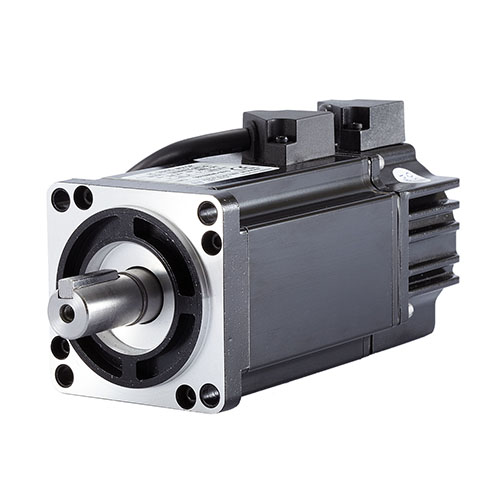
Medium Inertia Series Servo Motor